Superphosphate: NZ's most widely used phosphorus fertiliser

Last updated: 18 September 2026
Superphosphate has been a cornerstone of New Zealand farming for more than a century. It supplies plant-available phosphorus (P) and sulphur (S), two essential nutrients that many New Zealand soils are naturally low in.
For many established farming systems, superphosphate is used as a maintenance fertiliser to replace nutrients removed through production. It can also be used as a capital fertiliser where soil fertility needs to be built.
This guide explains what superphosphate supplies, where it fits in a fertiliser programme, and what long-term New Zealand research shows about its role in pasture production and clover growth.
Contents
- What is superphosphate and why is it used?
- How does superphosphate fit into a fertiliser programme?
- How much superphosphate does your farm need?
- What does superphosphate do for clover and pasture composition?
- What happens when superphosphate is withheld?
- Why is superphosphate still widely used in New Zealand?
What is superphosphate and why is it used?
Superphosphate is a phosphorus fertiliser that supplies plant-available phosphorus and sulphur, as well as calcium.
Phosphorus and sulphur are particularly important in New Zealand's clover and grass-based pastoral systems. Clover requires both nutrients to grow and contribute nitrogen to the pasture system through nitrogen fixation.
Mike Manning, Strategic Science Advisor, and Sarah Bassett, Senior Agri Manager, explain why superphosphate suits New Zealand pastoral systems and how it can be used to maintain soil fertility and pasture production.
How does superphosphate fit into a fertiliser programme?
Superphosphate can be used as either a capital or maintenance fertiliser.
A capital application is used where soil fertility needs to be increased. Maintenance fertiliser has a different role: replacing nutrients that leave the farm or are lost through normal production so soil fertility can be maintained.
Superphosphate is also flexible enough to be combined with other nutrients where they are required. Ravensdown's superphosphate-based range includes options that add potassium, magnesium, nitrogen or additional sulphur, including Potash Super, Magnesium Super, Nitrogen Super, Super Mag N, Sulphur Super and Serpentine Super.
The appropriate product and nutrient combination should reflect the requirements of the individual farm.
How much superphosphate does your farm need?
There is no single superphosphate rate that is right for every farm.
A maintenance fertiliser requirement is based on factors such as:
- Amount of product (e.g., meat, milk, wool) leaving farm
- soil type
- farm contour
- rainfall
- current soil fertility
- supplementary feed imported
Soil testing is an important part of this decision.
For phosphorus, the Olsen P soil test is used to assess plant-available phosphorus and help determine whether phosphorus is limiting production. The aim is to maintain an Olsen P level appropriate for the farm system, with phosphorus requirements and soil phosphorus management guided by soil test results rather than continuing to increase phosphorus where it is no longer limiting.
Long-term New Zealand trials demonstrate why this matters. At Winchmore, the 188 kg Super/ha treatment at an Olsen P of around 20 produced the same pasture growth as the 376 kg Super/ha treatment at an Olsen P above 40. In this situation, once Olsen P was around 20, phosphorus was no longer limiting pasture growth.
What does superphosphate do for clover and pasture composition?
Clover plays an important role in New Zealand pastoral farming because it fixes nitrogen from the atmosphere, which can then be recycled through the pasture system.
But clover has a less extensive root system than many grasses. In low-fertility conditions, grasses can therefore be more effective at accessing nutrients and outcompete clover.
Long-running New Zealand fertiliser trials show how increasing soil fertility can change that balance.
At the Winchmore long-term trial, superphosphate treatments averaged around 25% clover in the pasture, compared with less than 10% clover in the no-fertiliser control.
The fertilised treatments also contained more higher-fertility pasture species such as perennial ryegrass, while the no-fertiliser treatment contained more lower-fertility grasses such as Browntop.
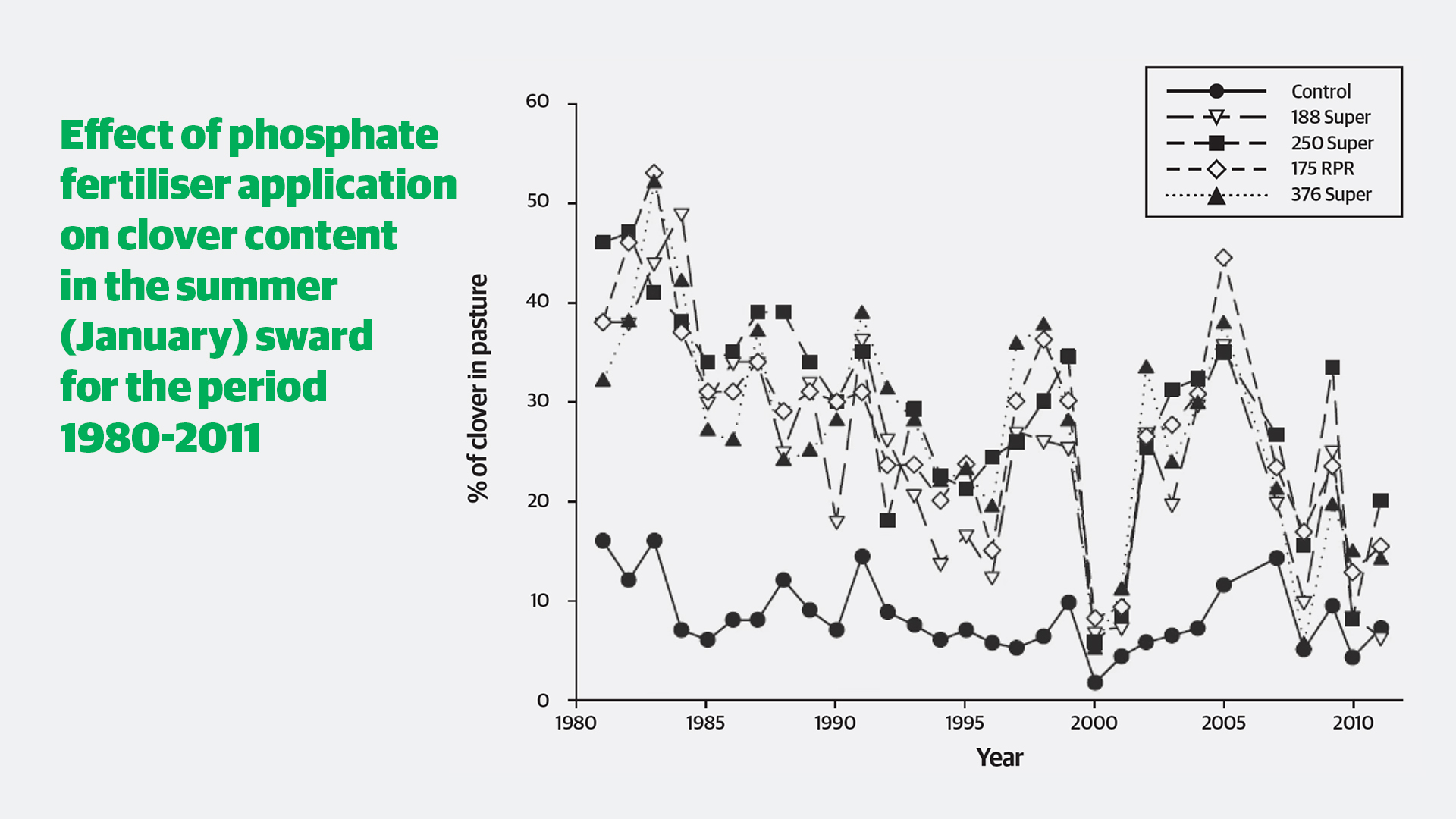
The results show that the effect of superphosphate is not simply about growing more dry matter. Maintaining phosphorus and sulphur fertility also influences the composition of the pasture, improving pasture quality and the ability of clover to compete within the sward.
Dr Will Talbot, Scientific Officer, explains what decades of research at the Winchmore Trials have shown about superphosphate, pasture composition, clover content and fertiliser withdrawal.
What happens when superphosphate is withheld?
Long-term trials also show what happens when phosphorus and sulphur inputs are removed and soil fertility begins to decline.
At Winchmore, fertiliser was withheld from some treatments for extended periods. Over time, pasture production fell as nutrients became limiting, and clover growth also declined.
How quickly a farm responds to reduced fertiliser inputs will vary depending on its starting soil fertility, soil type, production and other farm-specific factors.
When budgets are tight, paddocks can be prioritised according to where pasture growth is needed. Using farm soil test results, a fertiliser plan can then be developed to best fit both production goals and farm economics.
Why is superphosphate still widely used in New Zealand?
The fundamental principles of soil chemistry and plant physiology have not changed. Most New Zealand soils are naturally low in plant-available phosphorus and sulphur, and Superphosphate remains a cost-effective source of both nutrients.
Decades of New Zealand field research, including the long-running Winchmore trials, have demonstrated the effects of Superphosphate on pasture production and clover content.
Know what your soil needs before applying fertiliser
Knowing whether phosphorus and sulphur are limiting production is key to getting more from your pasture or crop. Soil testing helps identify your nutrient status, so you can make smart fertiliser decisions.
We're here to help. Contact your local Agri Manager or call our Customer Centre on 0800 100 123 to discuss your farm's requirements.


