Potassium fertiliser guide for New Zealand farmers

Last updated: 18 September 2026
Potassium (K), often referred to as potash, is one of the major nutrients required for pasture growth and animal production in New Zealand farming systems.
While some New Zealand soils contain substantial natural potassium reserves, many are naturally low in potassium or have become depleted after decades of productive farming. When potassium levels become limiting, clover production and nitrogen fixation declines followed by grass growth.
This guide explains what potassium fertiliser is, why it is used, how to assess your farm's potassium status, and the fertiliser options available to support pasture production.
Contents
- What is potassium fertiliser and why is it used?
- Which New Zealand soils are most likely to need potassium fertiliser?
- Types of potassium fertiliser in New Zealand
- How do you know if your farm needs potassium?
- Inputs and losses from the system
- When K pays and when it doesn't
What is potassium fertiliser and why is it used?
Potassium fertilisers are used to correct potassium deficiencies, maintain soil fertility, and support pasture production. Potassium Chloride (Potash) is one fertiliser used for this purpose.
Potassium is essential for both plants and animals.
In plants, potassium regulates the opening and closing of stomata, controlling the exchange of water vapour, oxygen and carbon dioxide in and out of the plant. It is also associated with the movement of water, nutrients and carbohydrates within plant tissues. Additionally, potassium is involved in enzyme activation, which affects the production of proteins, starch and energy for the plant.
In animals, potassium helps with nerve and muscle function, kidney function, carbohydrate and protein metabolism, water and electrolyte balance, and many other important biological processes.
Potassium also plays an important role in pasture composition. Grasses have larger and more extensive root systems than clovers and are generally better at extracting potassium from the soil. When soil potassium levels are low, grasses can outcompete clovers for available potassium, meaning clovers are more affected by potassium deficiency, resulting in reduced growth.
Maintaining adequate potassium levels helps improve clover content within mixed pasture swards and increase overall pasture production.
Dr Ants Roberts, Science Mentor, explains why potassium is important for pasture growth, legume performance and animal health.
Which New Zealand soils are most likely to need potassium fertiliser?
Natural potassium levels vary across New Zealand depending on soil parent material and climate.
Many young sedimentary and recent soils have naturally high levels of potassium, particularly those found on the east coast of the South Island and the lower North Island.
However, after 50 to 100 years of continuous farming, these natural reserves can become depleted.
Many New Zealand soils are naturally low in potassium, particularly:
- Ash soils
- Pumice soils
- Organic soils
- Highly weathered soils, including West Coast podzols
Types of potassium fertiliser in New Zealand
Several potassium fertiliser products are used across New Zealand farming systems.
The most appropriate product depends on the nutrients required, the farming system, soil conditions, and whether potassium is being applied on its own or alongside other nutrients.
| Fertiliser | What it supplies | When to use it | Key characteristics |
|---|---|---|---|
| Potash Super |
Potassium (5-25%), phosphorus, sulphur and calcium. Analysis varies by blend. |
Base or maintenance fertiliser where phosphorus, sulphur and potassium are required. |
Blend of Superphosphate and Potassium Chloride, with a wide range of K concentrations so the product can be matched to different potassium requirements. |
| Potash Sulphur Super |
Potassium (7.5-15%), phosphorus, sulphur and calcium. Analysis varies by blend. |
Maintenance applications where additional sulphur is also required. |
Contains both quick-acting sulphate sulphur and medium-term elemental sulphur. The elemental S component can suit infrequent applications or low-ASC soils in high-rainfall environments. |
| Potash Serpentine Super |
Potassium (7.5-15%), phosphorus, sulphur, magnesium and calcium. Analysis varies by blend. |
New pasture establishment or where magnesium deficiency is suspected or may occur. |
Blend of Serpentine Super and Potassium Chloride. Has a lower phosphate content than Potash Super. |
| Sulphate of Potash - Granular |
Potassium (42%), Sulphur (18%) |
High-value horticultural crops where sensitivity to chloride or salt makes Potassium Chloride less suitable. |
Virtually chloride free with a salt index of 46, compared with 114 for Potassium Chloride. |
| Granular Potassium Chloride | Potassium (50%) |
Pastoral, cropping and other chloride-tolerant crops. Used for both capital and maintenance applications, including replacing potassium removed through hay or silage. |
Cost-effective, quick-release potassium source with a higher potassium content than other fertilisers and dissolves readily. |
How do you know if your farm needs potassium?
Soil and herbage testing can help identify your farm's potassium requirements and whether potassium is limiting pasture production.
Quick Test K (QTK)
The main soil test used to measure plant-available potassium is the Quick Test K (QTK).
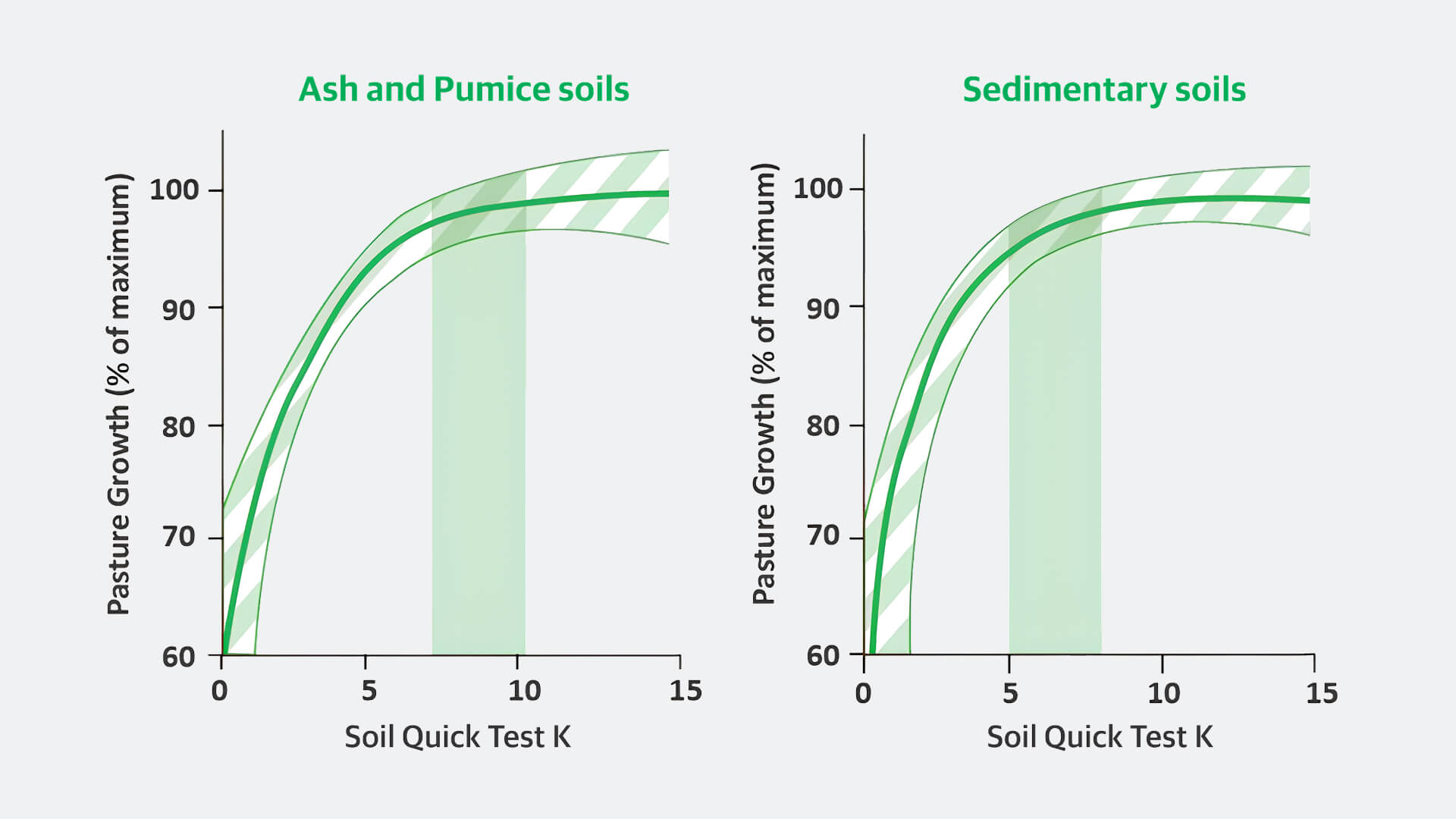
The graph below shows the relationship between relative pasture production and soil QTK for ash, pumice and sedimentary soils. The shaded areas show the optimal QTK ranges, which differ between ash and pumice soils and sedimentary soils.
Reserve K (TBK)
Some young sedimentary soils can supply considerable amounts of potassium through the gradual weathering of clay minerals.
This reserve potassium is not measured by Quick Test K.
The Reserve K test, also known as the TBK test, provides an indication of whether reserve potassium levels are low, medium or high.
For young sedimentary soils, using Quick Test K, Reserve K and clover potassium results together provide the best indication of a farm's potassium status.
Clover herbage testing
Clovers are more susceptible to potassium deficiency than grasses, making clover herbage testing a useful way to check for potassium deficiency.
Soil type affects interpretation
It can be challenging to raise potassium levels on coarse-textured ash soils, pumice soils, peat soils and podzol soils, particularly in high rainfall environments.
In these situations, both soil tests and pasture potassium levels should be used when assessing a farm's potassium status.
Inputs and losses from the system
Potassium can be both returned to and removed from paddocks through the farming system.
Inputs
Significant amounts of potassium can be returned to paddocks through:
- Farm dairy effluent
- Brought-in feed
- Recycling through urine
- Weathering of soil minerals
- Fertiliser applications
Losses
Potassium is removed from farming systems through:
- Hay and silage removal
- Animal products leaving the farm
- Transfer to stock camps and laneways
- Leaching from urine patches
Silage removal can be particularly significant. A 3 t DM/ha silage cut can remove around 75 kg K/ha from the farming system.
When K pays and when it doesn't
When considering the application of potassium fertiliser, it is important to take economics into account.
The optimal economic level for soil Quick Test K depends on the price of potassium fertiliser and the gross margin per hectare.
For most sheep and beef farms, the increase in pasture production from widespread potassium application is often not sufficient to be economically viable. Many sheep/beef/deer farms on sedimentary soils have reserve K supplies that maintain K supply at or above optimal ranges.
In comparison, most dairy farms can economically justify maintaining soil potassium levels within the optimum range for pasture production.
Know what your soil needs before applying fertiliser
Knowing whether potassium is limiting growth starts with knowing your farm's potassium status. Soil testing helps identify your potassium requirements, so fertiliser can be matched to what your farm needs.
We're here to help. Contact your local Agri Manager or call our Customer Centre on 0800 100 123 to discuss your farm's requirements.


